Over the past few years, I’ve gained a bit of a reputation for talking about mind mapping and why I think it’s a great resource for people to help untangle what is going on in their minds. Before we go into that, let’s look at what it means.
What is a Mind Map?
If you haven’t heard of the term mind mapping, you might have come across the term spider diagrams.
“A diagram used to visually organize information into a hierarchy, showing relationships among pieces of the whole. It is often created around a single concept, drawn as an image in the center of a blank page, to which associated representations of ideas such as images, words and parts of words are added. They connect directly major ideas to the central concept, and other ideas branch out from those major ideas.”
Wikipedia
But what’s my definition of it?
When I talk about it, I explain that it’s a great way of organising our thoughts, connecting the dots between information, a way of helping to remember information and a tool for problem-solving, brainstorming and creating strategies.
Examples of Mind Maps
There are different styles but one example that I often suggest is to use coloured pens and plain paper. The reason why I often suggest using this method is that it keeps things simple, whereas when you use technology, if you’re anything like me, your inner perfectionist might jump out. When you use pens and paper, it feels acceptable to keep it feeling raw rather than neat and tidy but this is all about personal preference.
If you’re wondering what the coloured pens are for, it’s to help you categorise the different elements you want to mind map, so that when you analyse and add to the different sections, it’s easier to see them at a glance.
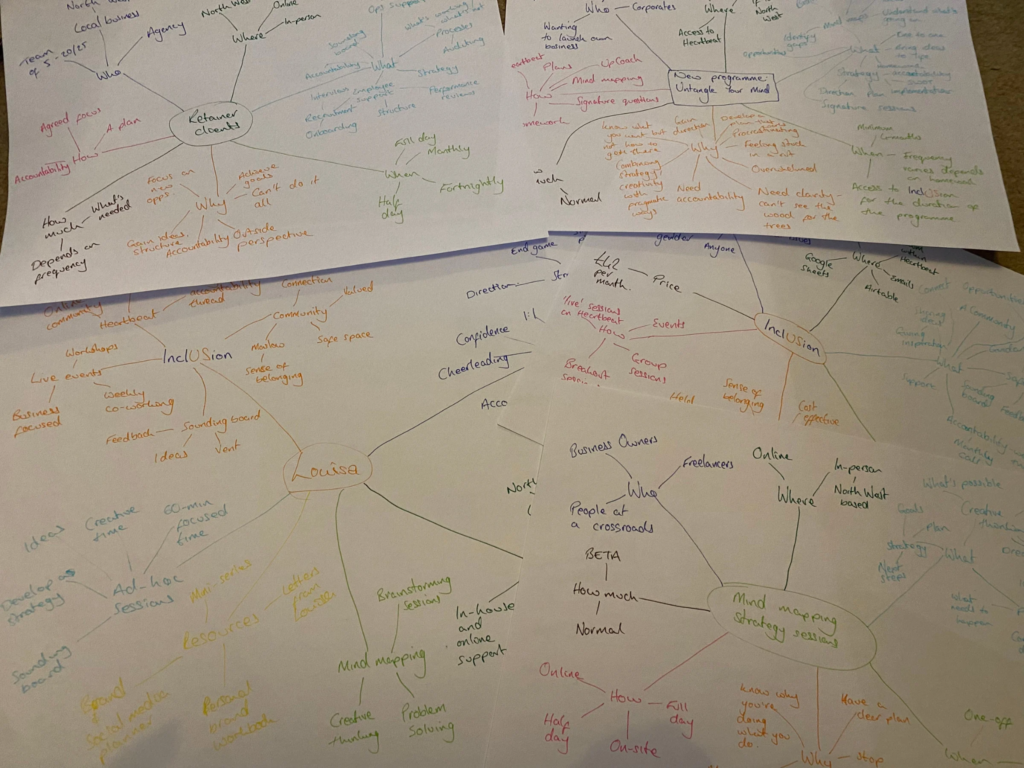
However, some people prefer to create mind maps using doodles of images and others prefer to use tech. It’s all about what works best for you but the principle remains the same.
What are the Advantages and Disadvantages of Mind Mapping?
Although I think it is a great tool, I know it doesn’t work for everyone, so let’s explore the advantages and disadvantages of mind mapping.
The Advantages of Mind Mapping
Explore your thoughts and ideas – How often do you feel a little stuck? You have lots of thoughts and ideas going through your mind but until you get it onto paper or on screen, it’s likely to stay there. Yes, you could create a list but that can feel a little restrictive and rigid, whereas going through this process allows your mind to fully wander and explore next steps.
Brainstorming – It’s a great tool for brainstorming on your own but also with family, friends and colleagues. You might think, why would you want to use a mind map with family and friends, well perhaps you’re looking to go away together, this is a great way for capturing everything that everyone wants to do.
Increase productivity – Not only do I use mind mapping day-to-day but I also use it with clients because it’s great for organising your thoughts and ideas and in return, that helps you to work more efficiently and effectively.
Improve communication – If you have a complex thought or idea, it’s not always easy to convey that to others but by expanding the thought or idea, you can highlight your thought process.
Encourages collaboration – If you’re working as a group, it’s a useful tool for collating thoughts and ideas.
The Disadvantages of Mind Mapping
It can be overwhelming – if you’ve never done it before, it can feel overwhelming because you could end up getting carried away by trying to include too much information but you might also find you end up staring at a piece of paper because you’re not sure where to start.
It can be time-consuming – Once you get started, it can be easy to lose track of time, especially if you start to overthink the information you’ve included. The same applies to mind mapping as a group, implement timeframes to avoid going over time and to stay focused.
Could be costly – If you decide to use specific mind mapping tools, the tech can be costly.
Lack of understanding – When I’ve spoken to people in the past about mind mapping, sometimes their response is they can’t do it because they’re not creative and because they have seen artistic doodle based maps but I always keep mine simple and use coloured pens and plain paper.
It can be messy – You need to know the purpose of why you want to mind map because otherwise you can start off on one topic and quickly think of different ideas/topics and before you know it, you don’t have enough space, so now you’re feeling even more overwhelmed.
Conclusion
Mind mapping is a great tool that can help you organise your thoughts and ideas. Anyone can do it and it can be as simple or complex as you make it. However, like with any tool, there are advantages and disadvantages to using it. It’s always important to know what your goals are before you start because this will help you stay on track.
Is your mind feeling chaotic right now?
Mind mapping is one of the tools I use with almost every client. It’s a brilliant way of untangling what’s going on in your head and turning it into something clear and actionable. If you’d like to experience that in practice, an Energiser Session is a focused 30, 60 or 90-minute conversation where we work through whatever’s going round in your head together. You bring the chaos. I help you find the pattern and bring calmness.
Book an Energiser Session. Prices start from £75.00.
Frequently Asked Questions about Mind Mapping
What is a mind map?
A mind map is a visual tool for organising thoughts and ideas. Unlike lists, it is a great way to see how things connect, especially when it comes to brainstorming, planning and problem-solving.
What are the main advantages of a mind map?
If you haven’t done it before or you are unsure of the process, it can feel overwhelming. It doesn’t work for everyone and for some, they prefer to use lists or more linear frameworks.
What are the disadvantages of mind mapping?
If you haven’t done it before, or you are unsure of the process, it can feel overwhelming. It doesn’t work for everyone and for some, they prefer to use lists or more linear frameworks.
Is mind mapping good for those with ADHD and autism?
Yes, because it doesn’t take a linear approach. It allows you to think more freely and explore those thoughts and ideas. I’m autistic and I strongly suspect I have ADHD, I find mind mapping allows me to be more creative and free flowing with my thinking.
Do I need software to mind map?
No. I never use software because I find it too distracting and I would want it to look too perfect. Using pens and paper works really well. However, software can be useful for collaborative or more complex mind maps.
About Louisa van Vessem

Hi, I’m Louisa van Vessem. A business mentor, consultant and facilitator for creatives and leaders who are stuck in their own heads.
I bring 15+ years of experience across HR, recruitment, strategy, analysis and executive support. I’ve been self-employed since 2017, I’m neurodivergent, and I’m solo parenting an autistic son. My lived experience shapes how I work just as much as my professional background.
If something in this post has made you think differently about your business, the best next step is a focused conversation. Book a free 20-minute call or an Energiser Session at ingeniouscorner.com. Let’s chat.
Let’s connect on social media: LinkedIn | Instagram – Ingenious Corner